
Peak Demand Management with Batteries: How to Reduce Your Hydro-Québec Electricity Bill
September 3, 2026 · 6 min
How a solar system paired with batteries lets Quebec businesses cut their power demand peaks and their electricity bill.

Hydro-Québec has 37,400 MW of available hydroelectric power, one of the largest renewable, clean hydroelectric resources in the world. On February 3, 2023, energy demand on Hydro-Québec's grid reached 43,124 MW during an Arctic cold snap when temperatures dropped to -52°C — a peak far beyond the roughly 21,000 MW called on during a milder day.
Quebec therefore has ample power generation capacity to meet the needs of all consumers, residential and industrial alike. But when every business and every home heats with electricity, draws heavily on power for industrial equipment, and charges electric vehicles, the instantaneous capacity (power) of Quebec's hydroelectric dams starts to run short.
What Is "Peak Demand Management"?
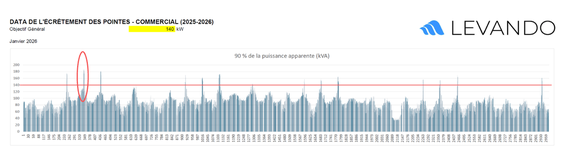
"Peak demand management" refers to limiting the maximum power a business draws at the moment it hits its daily power peak. Historically, companies managed peak demand with electronic load-shedding control systems: controllers delay when the most power-hungry equipment starts up, so it doesn't all run at once.
This approach is very cost-effective and can significantly reduce peak power demand, but it has a substantial shortfall: there's a real limit to how much energy a business can save this way without losing valuable productivity. Once every machine has been optimized, there are only two ways left to further reduce power draw: local energy production, and energy storage with batteries.
Why Solar Alone Isn't Enough: The Timing Mismatch
To produce energy, some businesses install generators, but the fuel they burn comes at a cost that makes this approach expensive, on top of maintenance, pollution, and noise concerns. The sharp drop in photovoltaic panel costs has made rooftop solar systems for businesses far more cost-effective — especially with Hydro-Québec incentives for commercial systems.
The problem: solar panels produce maximum energy around noon, while Hydro-Québec's demand peaks typically occur between 6 and 9 a.m. and between 5 and 8 p.m. — which doesn't line up at all with when panels are producing. The solution is to shift the timing between peak generation (noon) and peak consumption (5 p.m.) by storing the electricity on-site with batteries.
The Real Cost of Power Peaks
The sharp drop in lithium-ion battery costs in recent years has made this type of storage very attractive, on top of tax incentives offered by the Canadian government. For a commercial customer on Hydro-Québec's Rate M, for example, each kW of peak demand drawn by the building is billed at roughly $17.57 per month, and maximum consumption is measured in 15-minute intervals.
In practice: a business that consumes 300 kW on average, but draws 400 kW for just 15 minutes in a given month, will pay over $1,750 extra for that month — because of those 15 minutes alone. This is the case for many SMEs with power-hungry equipment used only occasionally: when that equipment starts up, the resulting power demand can significantly increase the bill, even if it only lasts a few minutes.
The Solution: Solar-Plus-Battery Storage, with No Fuel and No Noise
The commercial peak management approach involves limiting the amount of power drawn from the grid by using an external power source. A cost-effective solution is a lithium-ion energy storage system paired with solar panels, which stores electricity and discharges it when the building's demand rises above the usual threshold. These are simple, fully passive, automated systems that burn no fuel and run silently.
For example: 50 kW of solar panels combined with 200 kWh of batteries (100 kW of power for 2 hours) can shave a peak by at least 100 kW and save over $24,000 a year, accounting for net metering of the solar electricity, the monthly peak power reduction, and Hydro-Québec's GDP option. With applicable incentives (up to 40% of the solar system's value, a 30% tax credit on the solar system and batteries, plus accelerated depreciation), such a system can cost as little as about $100,000 for a business eligible for the tax credits — paying for itself in roughly 4 years.
Levando batteries are warrantied for 10 years and built to run for 20 (8,000 cycles), letting an energy-conscious plant owner recover more than two and a half times the invested capital over 10 years. To start an energy-efficiency project with solar panels and batteries, contact our team: our solar energy and lithium-ion storage experts can analyze your consumption profile and guide you through the process.
Contact us